12 Axes Quiz: How the 12-Axis Political Spectrum Works
For decades, political discussions have tried to force complex personal philosophies onto a single left-versus-right axis or a flat two-dimensional grid. The 12 Axes Quiz breaks away from this oversimplification by mapping your political perspectives across twelve independent spectrums divided into four comprehensive realms.
Whether you favor free markets yet champion technological regulation, or value strong national security while protecting personal privacy, this 12-axis assessment captures those nuances rather than cramming your views into an ill-fitting stereotype.

The 12 axes quiz charts political ideology across twelve independent spectrums spanning state power, diplomacy, economy, and culture.
What Is the 12 Axes Quiz?
The 12 axes quiz is an independent, browser-based political typology assessment that belongs to the lineage of multi-spectrum political tests. The family originated with open-source projects like 8values, expanded through 9axes, and reached full maturation in the 12-axis model.
Instead of answering loaded questions designed to push you toward one extreme, you rate straightforward statements on a five-point agreement scale: Strongly Agree, Agree, Neutral / Unsure, Disagree, and Strongly Disagree.
Each response adjusts your position along one specific axis without artificially distorting the others. The result is a personalized profile featuring twelve exact percentages, a visual multi-spoke wheel, and calibrated proximity matches to known ideologies, real-world nations, and historical thinkers.
Four Categories and Twelve Axes
The foundational strength of the 12-axis framework lies in its clean grouping. The twelve spectrums are organised into four balanced categories of three axes each, ensuring that every vital aspect of governance and society receives dedicated evaluation.
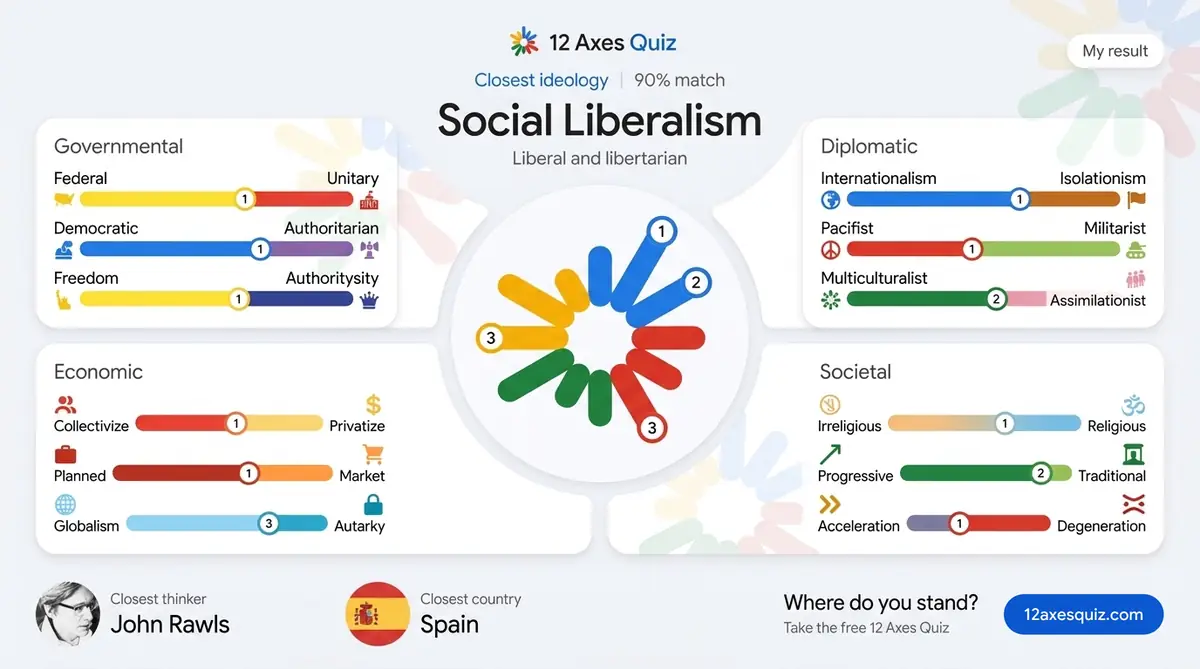
A sample result card displaying the twelve spectrum bars and radial wheel.
1. Governmental Realm (State & Power)
The governmental category examines how authority is structured, who holds legitimate decision-making power, and where the boundaries of law enforcement lie.
- Federal vs. Unitary (
fu): Balances devolved regional self-governance against consolidated national jurisdiction. - Democratic vs. Autocratic (
da): Contrasts transparent popular suffrage and electoral accountability with centralized executive command. - Security vs. Freedom (
sf): Measures whether civil privacy and individual expression take priority over preemptive policing and state surveillance.
2. Diplomatic Realm (Borders & Foreign Relations)
The diplomatic category evaluates a nation's relationship with the rest of the world, international treaties, and immigrant communities.
- Nationalism vs. Internationalism (
ni): Assesses whether state policy prioritizes domestic interests above all or engages in multilateral global organizations. - Militarist vs. Pacifist (
mp): Contrasts armed deterrence, defense spending, and military intervention with diplomacy, disarmament, and non-violent resolution. - Assimilationist vs. Multiculturalist (
am): Measures whether immigrants are expected to adopt host-culture customs or whether pluralistic cultural diversity is celebrated.
3. Economic Realm (Wealth & Markets)
Rather than treating economic ideology as a single slider, the framework splits commerce into three distinct operational questions.
- Collectivize vs. Privatize (
cp): Examines property ownership, public infrastructure, and common resources versus private enterprise and capital investment. - Planned vs. Laissez-faire (
pl): Weighs state price controls, regulatory oversight, and industrial planning against free-market deregulation and enterprise autonomy. - Isolationism vs. Globalism (
ig): Compares protectionist tariffs, import quotas, and domestic subsidies with open trade agreements and international commerce.
4. Societal Realm (Culture & Progress)
The societal category focuses on faith, traditions, family structures, and technological advancement.
- Irreligious vs. Religious (
ir): Measures strict secularism in public policy against faith-informed ethics and clerical institutional recognition. - Progressive vs. Traditional (
pt): Weighs dynamic social evolution and changing norms against historical preservation, continuity, and heritage. - Acceleration vs. Bioconservative (
ab): Evaluates rapid adoption of biotechnology, artificial intelligence, and human augmentation against ethical caution, precaution, and biological preservation.
| Category | Axis ID | Left Pole (0%) | Right Pole (100%) | Core Focus |
|---|---|---|---|---|
| Governmental | fu | Federal | Unitary | Division of regional vs central authority |
| Governmental | da | Democratic | Autocratic | Distribution of political franchise |
| Governmental | sf | Security | Freedom | State authority vs civil liberties |
| Diplomatic | ni | Nationalism | Internationalism | National focus vs multilateral treaties |
| Diplomatic | mp | Militarist | Pacifist | Military force vs peaceful arbitration |
| Diplomatic | am | Assimilationist | Multiculturalist | Cultural uniformity vs diverse integration |
| Economic | cp | Collectivize | Privatize | Public ownership vs private capital |
| Economic | pl | Planned | Laissez-faire | Regulatory management vs market pricing |
| Economic | ig | Isolationism | Globalism | Protectionism vs free international trade |
| Societal | ir | Irreligious | Religious | Secular governance vs faith principles |
| Societal | pt | Progressive | Traditional | Social change vs heritage preservation |
| Societal | ab | Acceleration | Bioconservative | Tech adoption vs precaution and restraint |
How Scoring and Matching Work
Behind the clean user interface, the 12 axes quiz operates on a vector space model. Your profile is represented mathematically as a 12-dimensional vector:
where each percentage represents your balance on that specific axis.

Scores are mapped against documented positions held by political thinkers, parties, and global systems.
Matching Proximity Metrics
Once your vector is calculated, the system performs distance comparisons against pre-calibrated reference profiles using the normalized Euclidean distance formula:
and determines the similarity match score:
This calculation produces three intuitive comparison outcomes:
- Closest Ideology Match: Determines which structured political philosophy—such as Social Democracy, Classical Liberalism, Ordoliberalism, or Syndicalism—most closely mirrors your vector.
- Closest Country Match: Compares your positions with governance and economic systems across dozens of sovereign nations, identifying which real-world policies most resemble your preferences.
- Closest Historical Thinkers: Compares your axis results with documented writings of renowned philosophers such as John Rawls, John Stuart Mill, Adam Smith, or Albert Camus.
Test Lengths and How to Take It
Different situations call for different levels of depth. You can take the 12 axes quiz directly at 12axesquiz.com across three carefully calibrated question tiers:
- Quick Version (36 Statements): Takes roughly 3 to 4 minutes. With 3 statements dedicated to each axis, it provides a fast snapshot ideal for casual discovery or classroom introductions.
- Standard Version (60 Statements): Takes approximately 6 to 8 minutes. Allocating 5 statements per axis, this is the recommended baseline balance between speed and statistical consistency.
- Full Version (120 Statements): Takes about 12 to 15 minutes. With 10 balanced statements per axis, it yields the most nuanced, steady result by testing your responses against diverse situational contexts.
Regardless of which length you select, every statement is paired with equal weight and unbiased phrasing, ensuring that agreement or disagreement stems purely from your convictions.
12 Axes Quiz vs Political Compass
The familiar two-axis Political Compass has entertained internet communities for decades, but modern political realities frequently strain its boundaries. Here is how the two approaches compare:
| Feature | Traditional 2-Axis Compass | 12 Axes Quiz |
|---|---|---|
| Total Dimensions | 2 (Economic Left/Right, Authoritarian/Libertarian) | 12 across 4 balanced categories |
| Foreign Policy | Collapsed into social/libertarian scores | 3 distinct diplomatic axes (nationalism, defense, integration) |
| Trade vs Welfare | Blended together onto one economic slider | Separated into ownership, state planning, and international trade |
| Technology & Science | Completely absent | Dedicated Acceleration vs Bioconservative spectrum |
| Result Representation | Single static dot on a square coordinate grid | 12 distinct percentages, a 12-spoke radial icon, and ranked matches |
| Country Comparison | Rare and unstandardized | Built-in matching across dozens of modern nations |
By separating dimensions that other tests conflate, this multi-dimensional model allows you to discover where your views diverge from standard political party lines.
Privacy and Browser-Based Architecture
In an age where data brokers scrape personality and political tests for targeted advertising, digital privacy is essential.
The web implementation at 12axesquiz.com is built with a client-side architecture:
- Zero Server Storage: Your answers are never transmitted to a central database or saved on a remote server.
- Browser-Local Calculation: All scoring math runs locally in JavaScript inside your browser session.
- No Mandatory Registration: No account creation, passwords, or emails are requested.
- Stateless Sharing: When you share your result card, the URL carries only the twelve percentage numbers encoded in the link hash, leaving no persistent tracking breadcrumb behind.
Who Should Try the 12 Axes Quiz?
The assessment is designed for anyone curious about political theory, civics, or personal philosophy:
- Curious Citizens: Discover why you feel dissatisfied with conventional two-party labels or binary political categories.
- Educators & Students: Introduce political science concepts in an approachable, engaging format that demonstrates how governance, diplomacy, and trade interact.
- Discussion Groups: Compare multi-axis results among colleagues and friends to see the exact points of consensus and debate without tribal hostility.
Taking the quiz takes only a few minutes, yet the clarity provided by twelve distinct spectrums offers a much richer portrait of what you believe and why.
Frequently asked questions
What is the 12 axes quiz?
The 12 axes quiz is a multi-dimensional political typology test that evaluates your viewpoints across twelve separate spectrums in four broad categories: Governmental, Diplomatic, Economic, and Societal.
How does the 12 axes quiz differ from the traditional Political Compass?
The classic Political Compass compresses all human political thought into only two axes (Economic and Social). The 12 axes quiz separates foreign policy, trade openness, civil liberties, religion, and technological progress onto distinct independent spectrums.
Does 12axesquiz.com store or share my quiz answers?
No. All score calculations occur entirely within your web browser using client-side JavaScript. Your individual answers never leave your device, and shareable result links contain only the twelve percentage values.
How long does the 12 axes test take to finish?
It offers three distinct statement lengths: Quick (36 statements, ~4 minutes), Standard (60 statements, ~7 minutes), and Full (120 statements, ~12 minutes).
What matches do I receive at the end of the test?
Your final twelve percentages are matched against a database of political ideologies (such as Social Liberalism or Democratic Socialism), modern country governance profiles, and historical political philosophers.
Is the 12 axes quiz completely free to take?
Yes. The test is free, open access, and requires no account registration, email sign-up, or paywall.